Post by db on Oct 14th, 2006 at 4:35pm
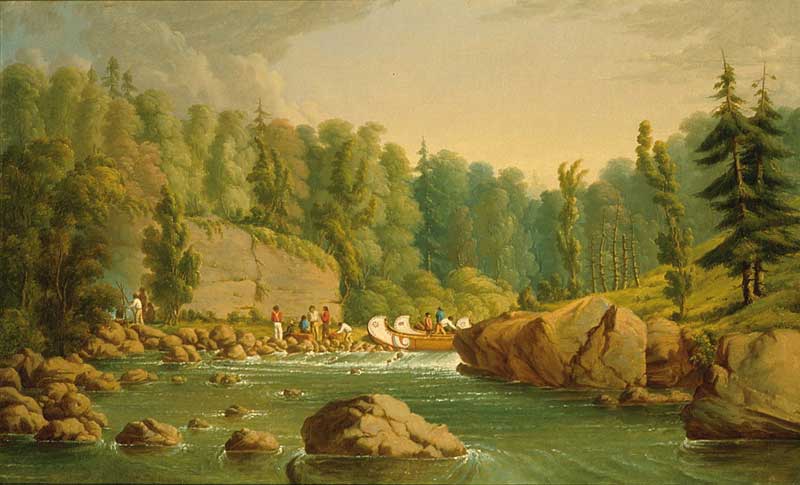
French River Rapids
by Kristy Noftall
by Kristy Noftall
For the past century, a famous painting titled “French River Rapids” was thought to be an image represented at Georgian Bay, but a recent discovery by Ken Lister of the Royal Ontario Museum has proven the painting to be Quetico Provincial Parks’ own French River.
Paul Kane (1810-1871) was a famous artist known to be one of the first Canadian artist-explorers to record life in the Canadian Northwest before white settlement. Over two journeys between 1845 and 1848, Kane travelled across thousands of miles with the fur trade canoe fleets, writing journal entries and sketching First Nations peoples in their homelands and collecting Indian legends.
In 1848 when Kane returned to Toronto he had made more than 600 sketches of scenery and of First Nations from some 80 bands. In his Toronto studio he then used the sketches as inspiration for more formal oil paintings. There are two almost identical images by Kane titled “French River Rapids.” One is an oil on paper sketch (34.3 cm x 60.6 cm) located at the Stark Museum of Art in Orange, Texas and the other is a oil on canvas painting (H 87 cm x W 59 cm) in the Royal Ontario Museum collection.
Interested in the comparison between Kane’s field sketches and actual oil paintings, Lister, Assistant Curator of Anthropology at the Royal Ontario Museum, began to wonder if some of Kane’s sketches were from his imagination or if they were actual sites.
“Since there is a sketch of the French River Rapids and one that he (Kane) used as a foundation for his oil painting it is unlikely that the image is one of the imagination, but rather it is a view of an existing site,” says Lister.
Kane’s own book “Wanderings of an Artist” show that at the time he sketched this image he wasn’t at the French River that drains Lake Nipissing into Georgian Bay, but describes the site of the famous French Portage in Quetico.
Lister also notes, “There is no evidence to suggest that Kane actually visited the southern Ontario French River as he does not mention it in his journal and even his travel map published in 1859 does not show him near the French River.”
From Paul Kane’s book, published in 1859, his entry for May 30th 1846 reads, —We made an early start, reaching the “French Portage” by breakfast-time. Here we lightened the canoes of the principal part of the baggage, and carried it across the portage, a distance of three miles, in order that we might be able to send canoes round by the river, which had now become very shallow, to meet us at the further end of the portage. We camped this evening at a small lake called Sturgeon Lake, having come a distance of forty-eight miles, passing “French Portage,” and “Portage des Morts.” All of these lakes names are on the chain through Quetico.
Lister traveled from Toronto to Quetico to find the site of the image which lies at the east end of the French Portage north of Highway 11.
“Although the river end of the French Portage is heavy with trees and undergrowth; by locating yourself down river from the rapids you can see the clear correspondences between the Kane sketch and the current condition of the river,” says Lister. “From down river the vertical rock wall that Kane paints is not visible but it is most definitely there and can be seen if one stands at the rapids.”
Upon discovery of the site, Lister visited the Quetico Park Information Pavilion at Dawson Trail Campground. Here he spoke with Andrea Allison, Librarian and Shirley Peruniak, Park Historian. Lister also used the John B. Ridley Research Library to research historical information on the French Portage and the Dawson Route.
The French Portage is a very important part of Canadian history and of Quetico history. It was used by surveyors, explorers, fur traders and was located along the only route at one time in Canada that headed west. “The discovery of the painting further emphasizes the importance of this historic portage,” said Allison.
In 1968, the excavation of an old east end way station located at the French Portage that was used during the time of the Dawson Route (1868-1879) to accompany travellers, led to a Quetico boundary extension. If the boundary hadn’t been extended, Kane’s painting wouldn’t actually be in the park boundary but just outside.
The trail leading to the site of Kane’s painting is overgrown and unmarked, but one can walk there and locate the site of the painting, something Allison did. “This site gives a visual picture of Quetico’s past,” says Allison, “Having a picture is worth a thousand words.” “I think the discovery is pretty significant. Paul Kane is quite a famous artist and to know he painted it right here (Quetico Park) brings history to life,” said Allison.
Credit: French River Rapids, Courtesy of the Royal Ontario Museum, © ROM
Compliments: Andrea Allison & Robin Reilly (MNR)
 French-River-Rapids_ROM.jpg ( 46 KB | 0
Downloads )
French-River-Rapids_ROM.jpg ( 46 KB | 0
Downloads )